Framework v.2026.06
VERIFICATION
STANDARDS
NotADoc Club operates as an independent bridge between computer vision engineering and clinical application. We neutralize vendor bias through a rigid framework designed to audit medical imaging automation before it touches a patient record.
VISION DYNAMICS
The NotADoc Verification Framework is built on the principle that algorithmic transparency is a clinical requirement, not a technical feature. We assess imaging automation through four distinct pressure points to ensure workflow integration safety.
99.8%
Consistency Threshold for Tier 1 Certification
Data Integrity
Verification of training set diversity and noise ratios. We audit the signal-to-artifact balance to ensure neural vision models aren't learning from hardware flaws rather than pathology.
Model Transparency
A deep audit of the decision pathways. We map how computer vision applications conclude specific findings, eliminating "black box" logic in favor of explainable clinical markers.
Inference Speed
Benchmarking processing latency within actual hospital network environments. High detection performance is useless if it creates diagnostic bottlenecks during acute triage.
Drift Mitigation
Ongoing monitoring protocols for performance decay. As equipment ages or clinical software updates, we verify that the automation adapts without losing diagnostic fidelity.
RE-CODING THE CLINICAL EYE
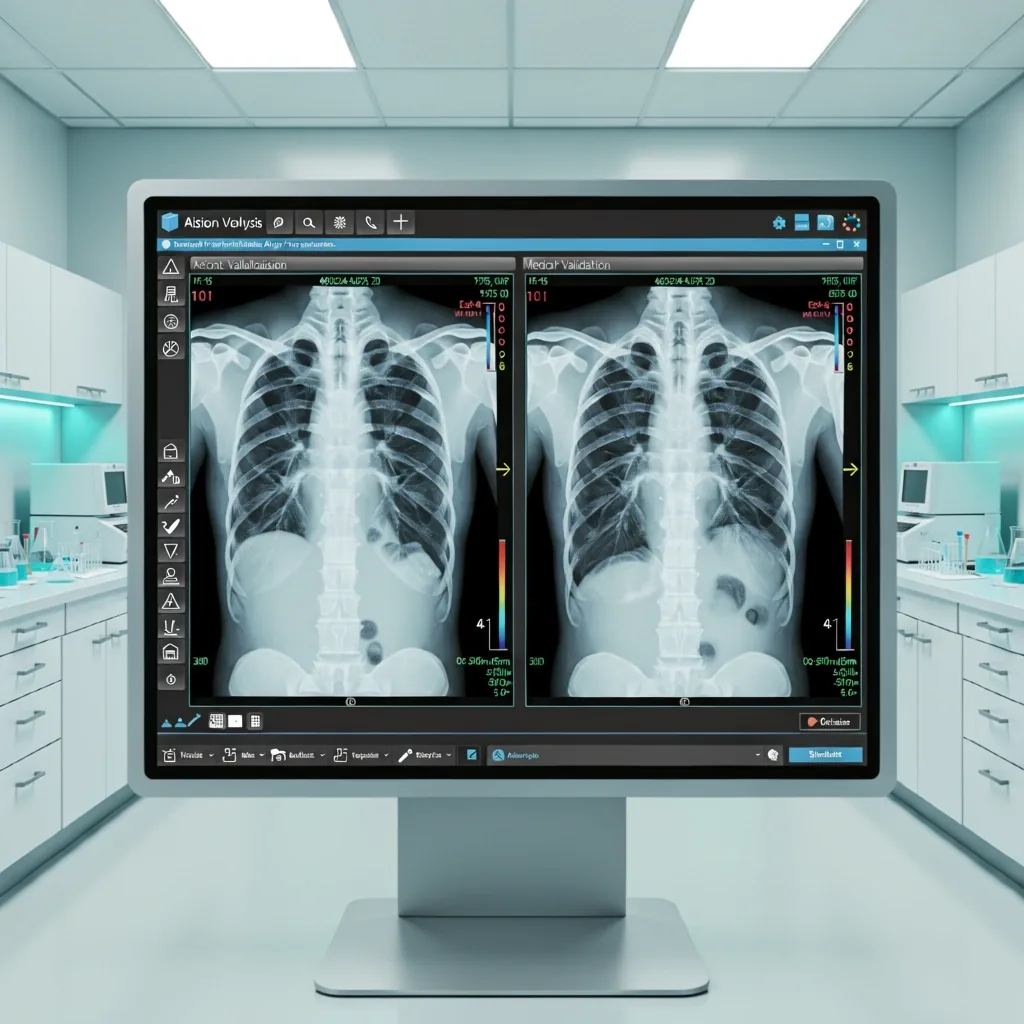
Modern healthcare struggles not with a lack of data, but with an excess of unverified automation. NotADoc Club provides the neutral ground where computer vision technologies are dissected to reveal their true operational limits.
Our consulting process strictly separates technical performance from clinical diagnosis. We don't tell you how to treat patients; we show you exactly how your software sees them, allowing for a safer path to diagnostic imaging automation.
Latest Policy Review: June 2026
Verification protocols updated to align with the latest research on drift monitoring in multimodal vision models.

ACTIVE AUDIT PROGRAMS
Pattern Recognition Integrity
Assessment of rule-based vs. neural vision outcomes in high-throughput environments. This program focuses on edge-case detection and bias avoidance in automated triage lists.
Workflow Latency Mapping
A diagnostic of how automation impacts radiology throughput. We map data storage limits, network traffic spikes, and processing delays that compromise clinical efficiency.
Statistical Decay Tracking
An ongoing service that detects when a model’s performance begins to deviate from its verified baseline due to shifts in hardware calibration or site-specific data types.

JOIN THE
EXPERTS
NOTADOC CLUB DISCLOSURE
We do not provide medical diagnoses or patient treatment plans. We do not claim 100% accuracy for any computer vision algorithm. We provide technical verification and process consulting only.
Operational Hub:
1000 Rue De La Gauchetière O
Montréal, QC H3B 4W5, Canada